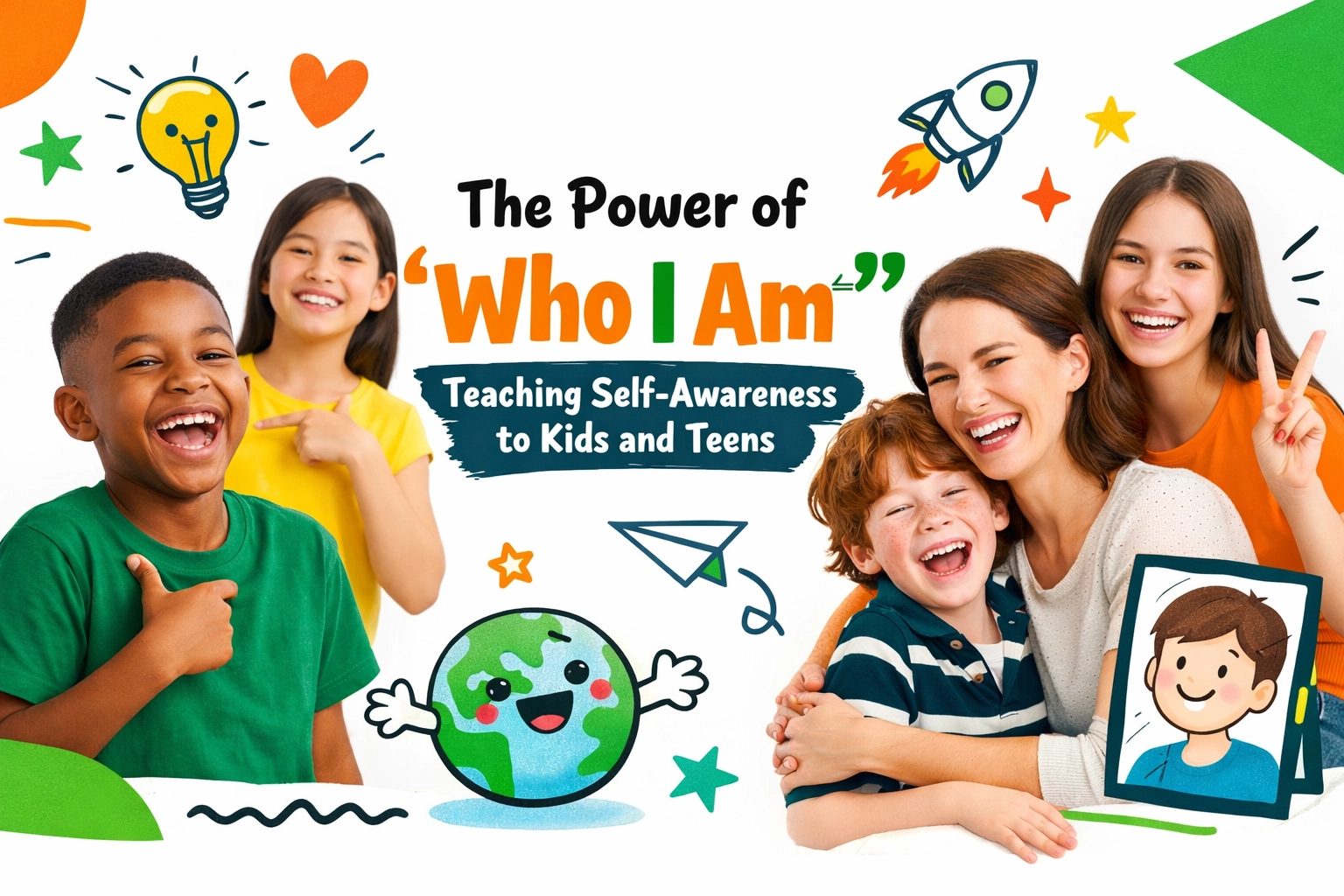
Your child's ability to understand themselves, their emotions, their strengths, their triggers, isn't just a nice-to-have skill.
It's the foundation of everything else.
Self-awareness is the quiet superpower that determines how your teen handles peer pressure, how your 10-year-old responds to disappointment, and how both navigate the overwhelming flood of information and choices they face daily.
In today's world, where kids are constantly told who to be by social media, influencers, and cultural trends, teaching them to ask "Who am I, really?" is an act of revolutionary parenting.
Let's talk about why this matters, and how you can start building this skill in your home today.
Here's something that might surprise you: students who participate in social-emotional learning programs that explicitly teach self-awareness show an 11-percentile-point gain in academic performance compared to their peers.
But the impact goes far beyond grades.
When a child truly knows themselves, their emotional patterns, their values, their God-given strengths, they make better decisions. They can pause before reacting. They can name what they're feeling instead of being controlled by it.

Better Decision-Making
A self-aware teen doesn't just react to situations; they respond with intention.
They can evaluate choices clearly because they understand their own values and can anticipate consequences. When everyone at school is doing one thing, they can ask themselves: "Is this aligned with who I am and who I want to become?"
That's not rigidity, that's clarity.
Emotional Regulation That Actually Works
Think about the last time your child had a meltdown over something that seemed small to you but felt monumental to them.
Self-awareness teaches kids to identify emotions before they become overwhelming. Instead of saying "I'm fine" when they're clearly not, they learn to say: "I'm feeling frustrated because I tried really hard and it didn't work out."
That's not just vocabulary, it's mastery.
Stronger Relationships
Kids who understand their own emotional landscape develop empathy for others almost automatically.
They can recognize when a friend is struggling because they've learned to recognize those same feelings in themselves. Proverbs 20:5 reminds us: "The purposes of a person's heart are deep waters, but one who has insight draws them out."
Self-awareness gives your child the tools to understand both their own heart and the hearts of others.
Here's the reality: most children aren't being taught self-awareness systematically.
Schools focus on reading, writing, and math, all essential, of course. But who's teaching your child to read their own emotional signals? To identify what makes them anxious, angry, or joyful?
As parents, we can fill this gap. And it doesn't require a psychology degree.
It requires intentionality.

1. Start with Emotion Journals
Give your child a simple notebook, nothing fancy, just a space that's theirs.
Each evening, have them write down three things:
This practice helps children connect the dots between external events, internal feelings, and physical sensations. Over time, they'll start recognizing patterns: "I always feel anxious before tests" or "I get angry when I feel like I'm not being heard."
That recognition is power.
2. Model Your Own Self-Awareness
Your kids are watching you more than you realize.
Narrate your emotional experiences out loud: "I'm feeling frustrated right now because the traffic made me late. I can feel my shoulders getting tense. I'm going to take three deep breaths and choose how I want to respond."
This isn't oversharing, it's teaching.
You're showing them that emotions are normal, manageable, and don't control us when we acknowledge them.
3. Create a 'Strengths and Growing Areas' List
Help your child make two lists: things they're genuinely good at, and areas where they're still learning.
This isn't about building overconfidence or crushing their spirit, it's about honest self-assessment. A child who knows they're great at encouraging friends but struggle with time management has clarity about how to navigate their world.
They can lean into their strengths and ask for help with their growing areas without shame.

4. Teach Them to Identify Triggers
Ask your child: "What situations or people tend to bring out the best in you? What situations make you feel defensive or upset?"
Maybe large groups overwhelm them. Maybe competition energizes them. Maybe criticism shuts them down before they can process it.
When they understand their triggers, they can prepare for them, or sometimes, avoid them altogether.
5. Practice Mindfulness Together
Even 10 minutes of mindfulness practice can significantly improve emotional regulation in teens.
This doesn't have to be complicated. Sit together and simply focus on breathing. Ask: "What do you notice in your body right now? Where do you feel calm? Where do you feel tension?"
This builds the muscle of paying attention to their inner world, a skill that will serve them for life.
Daily Check-Ins
Before dinner or bedtime, ask: "On a scale of 1-10, how are you feeling today? What made it that number?"
You're not looking for a thesis, just a moment of reflection. Over time, this becomes second nature.
The 'Why' Game
When your child expresses a strong preference or reaction, gently ask: "Why do you think you feel that way?"
Not in an interrogating way, in a curious way.
Help them dig deeper than surface answers. "I don't like that person" can become "I feel nervous around them because they're really confident and I worry I'll say something silly."
That's insight.
Goal Setting and Reflection
Help your child set small, achievable goals, not just academic ones.
Maybe it's "I want to speak up more in group projects" or "I want to stop comparing myself to my sister."
Then reflect together: What worked? What didn't? What did you learn about yourself in the process?

A self-aware 12-year-old doesn't have it all figured out.
But they can say things like:
That's not adult-level emotional intelligence: it's age-appropriate self-knowledge. And it's transformative.
Teaching self-awareness isn't separate from raising children in faith: it's central to it.
Psalm 139:23-24 invites this kind of introspection: "Search me, God, and know my heart; test me and know my anxious thoughts. See if there is any offensive way in me, and lead me in the way everlasting."
When we teach our children to understand themselves: their thoughts, their emotions, their patterns: we're teaching them to be honest before God and themselves. We're preparing them to live with integrity and purpose.
That's not just life skills: it's discipleship.
You don't need to overhaul your entire parenting approach.
Start with one practice. One conversation. One moment where you pause and help your child name what they're feeling instead of stuffing it down or acting it out.
Self-awareness is built brick by brick, conversation by conversation, reflection by reflection.
And you're exactly the right person to guide your child through this journey.

Self-awareness is just one piece of the puzzle: but it's the piece that makes everything else possible.
When children understand themselves, they're better equipped to handle money, navigate relationships, discover their purpose, and stand firm in their values.
That's why we created the Complete life skills platform: 14 essential courses that give your child the foundation they need to thrive: emotionally, spiritually, practically, and relationally.
From Financial Literacy to Digital Safety to Purpose Discovery, every course builds on the others to create young people who know who they are and where they're going.
We invite you to explore the Complete life skills platform at £19.99/month and give your child tools that will serve them for a lifetime.
Start the Complete life skills platform
Have questions? Call our team at +44 121 823 1456 or message us on WhatsApp: we're here to help.
Your child's journey toward self-awareness, confidence, and purpose starts now.