Let's talk about the question that's probably crossed your mind at 2 AM when you're worrying about your teen's future.
Is it better for them to ace their GCSEs: or to actually know how to handle stress, disappointment, and real-life relationships?
Here's the thing: we've been taught that this is an either-or question. That we have to choose between academics and emotional intelligence.
But what if I told you that's a false choice?
For years, parents (myself included) have obsessed over test scores, university applications, and that perfect grade point average.
Meanwhile, our teens are drowning in anxiety, struggling with basic emotional regulation, and entering adulthood without knowing how to navigate conflict or failure.
The education system has told us that academic achievement is the ticket to success.
And sure: good grades matter. But they're not the whole story.

Here's where it gets interesting.
A 40-year study from UC Berkeley found that emotional intelligence is nearly four times more powerful than IQ at predicting future success.
Read that again. Four times.
But it gets better. Emotional intelligence doesn't compete with academic success: it actually supports it.
Students with higher emotional intelligence consistently earn better grades and test scores. This holds true even after controlling for general intelligence and personality traits.
So when we ask "Which skill will help my teen thrive?": the answer is both. And EQ is the foundation that makes academic achievement possible.
Let's get practical for a moment.
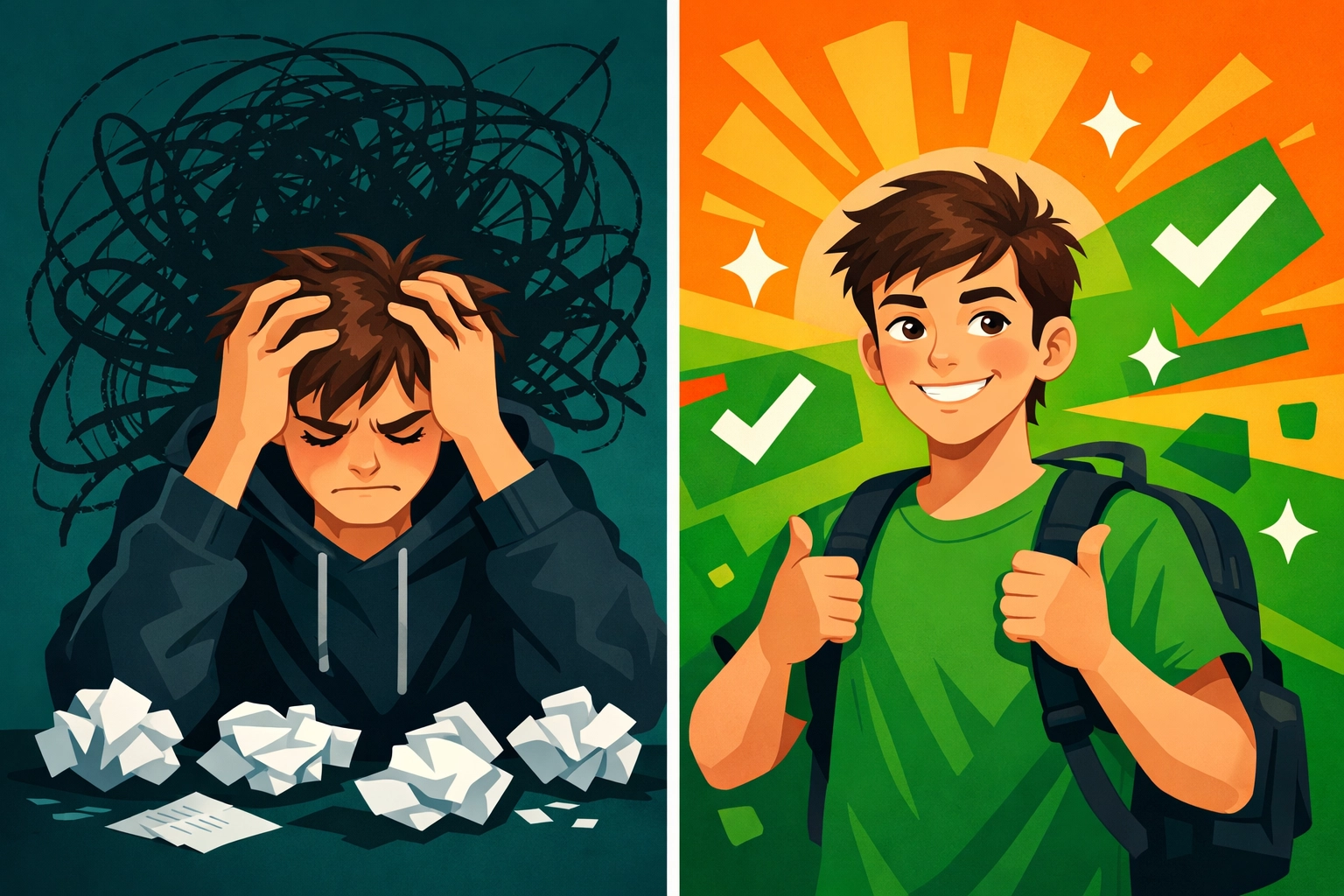
Your teen sits down to revise for their chemistry exam. They're stressed. They're overwhelmed. They're convinced they're going to fail.
A teen with low emotional intelligence? They spiral. They procrastinate. They give up before they've even started.
A teen with developed emotional intelligence? They recognize the anxiety, name it, and use coping strategies to manage it. They break the work into manageable chunks. They ask for help when needed.
Same intelligence. Same textbook. Completely different outcome.
Research shows that students with higher EQ manage negative emotions like anxiety, boredom, and disappointment more effectively: which directly improves learning.
They adopt better coping strategies including reflection, organization, and time management. They avoid procrastination and other counterproductive behaviors that tank academic performance.
Here's something we don't talk about enough: emotional intelligence isn't just about managing your own emotions.
It's about relationships.
Students skilled at managing emotions build stronger connections with teachers, peers, and family: all crucial for academic success.
Think about it. The teen who can communicate respectfully with their teacher gets more support. The teen who knows how to navigate peer pressure makes better choices. The teen who can regulate their emotions at home creates a more stable learning environment.
Proverbs 16:32 tells us, "Better a patient person than a warrior, one with self-control than one who takes a city."
Self-control. Patience. These are emotional intelligence skills: and they're biblical values we're called to develop in our children.
Adolescence is hard.
For teens specifically, emotional intelligence predicts adaptation, well-being, and academic performance while protecting against school burnout and anxiety.
Your teen is navigating:
Without emotional intelligence, these challenges become overwhelming. With it? They become opportunities for growth.
Students who manage emotions effectively feel more engaged with schoolwork and develop higher self-esteem, which motivates committed effort in academic challenges.
They're not just surviving school: they're thriving in it.
Here's what gives me hope: emotional intelligence isn't a fixed trait.
It can be taught. It can be learned. It can be developed.
You don't have to accept that your teen "just isn't good with emotions" or "struggles with stress management."
These are skills. Like learning to drive or cook or manage money: they can be practiced and improved.

Research confirms this again and again. EQ programs show measurable improvements in students' ability to:
As a parent, you have the opportunity to equip your teen with these skills now: before they face the even bigger challenges of university, work, and adult relationships.
So how do you actually develop emotional intelligence in your teen?
Start with awareness. Help them identify and name their emotions. "You seem frustrated" is more helpful than "Why are you being difficult?"
Model it yourself. When you're stressed, say it out loud: "I'm feeling overwhelmed right now, so I'm going to take five minutes to calm down before we discuss this."
Create space for emotional conversations. Ask "How did that make you feel?" instead of just "What happened?"
Teach coping strategies. Deep breathing. Journaling. Physical exercise. Prayer and meditation.
Connect it to faith. Help them see that emotional regulation is part of stewarding the body and mind God gave them.
Here's the truth we need to embrace: your teen needs both academic skills and emotional intelligence.
Not one or the other. Both.
The good news? When you invest in emotional intelligence, you're actually setting them up for better academic performance too.
You're not sacrificing their education by teaching them life skills. You're enhancing it.
Approximately 4 percent of differences in student academic performance can be attributed to emotional intelligence: which might not sound like much until you realize that's the difference between a B and an A, or between getting into their dream university or not.

But more importantly, you're preparing them for life. For marriage, parenting, career challenges, financial stress, health crises, and everything else that won't show up on a transcript.
If you're feeling overwhelmed by all this, I get it.
You're already juggling work, household responsibilities, church commitments, and trying to keep your teen alive and relatively functional.
Adding "teach emotional intelligence" to your mental to-do list feels like just one more thing you're failing at.
But what if someone handed you a roadmap? A structured program that covers not just emotional intelligence, but also financial literacy, digital safety, puberty education, and character building?
That's exactly what the Complete Life Skills Bundle is designed to do.
We've created faith-based, practical lessons that fit into your busy life: not add to the chaos.
Right now, the bundle is £19.99 per month. That's less than a family meal out, for resources that will equip your teen for life.
Call our team at +44 121 823 1456 to learn more, or message Rachel on WhatsApp at https://wa.me/447361653024 with any questions.
Your teen doesn't have to choose between being emotionally intelligent and academically successful.
In fact, they can't fully achieve one without the other.
Emotional intelligence is the foundation that makes academic achievement possible: and more importantly, it's the skill set that will serve them long after the last exam is written.
As Christian parents, we're called to raise children who are "wise in heart" (Proverbs 16:21), not just intellectually accomplished.
So let's stop asking "Which skill matters more?" and start asking "How can I equip my teen with both?"
Because that's how they'll truly thrive: in school, in life, and in faith.







Comments are closed