In a world that screams for our children’s attention, the quietest voice they often ignore is their own.
We spend so much time teaching them how to navigate the internet, how to solve for X, and how to kick a ball, but we often forget the most critical curriculum of all, understanding who they are.
Self-awareness isn't just a "soft skill" or a buzzword for corporate retreats.
It is the foundation of confidence, the bedrock of resilience, and the internal compass that keeps a child steady when the world tries to push them off course.
As a parent, you understand that confidence isn't about being the loudest in the room.
It is about knowing what you bring to the table, and what you don't.
At Empower Kidz and Teenz Academy, we believe that raising a child who knows themselves is an act of stewardship.
We are not just raising kids, we are preparing souls for their purpose.
So, let's talk about how we can help them find that internal anchor through ten practical, engaging activities.
The mind of a child is a busy place, filled with half-formed thoughts and big emotions that they often don't have words for yet.
Journaling isn't about perfect grammar or beautiful handwriting, it is about creating a safe harbor for their inner world.
You might start by giving them a prompt: "What is one thing you did today that made you feel strong?"
When children write down their successes and their struggles, they begin to see patterns in their own behavior.
They start to recognize their own growth, which is the most authentic source of confidence there is.
Proverbs 4:23 tells us to "Keep your heart with all vigilance, for from it flow the springs of life."
Teaching them to journal is teaching them to watch over their own hearts.
The world will never be shy about telling your child who they aren't.
If we don't teach them to speak the truth over themselves, they will eventually believe the lies that social media or playground bullies whisper.
Work with your child to create a set of "I Am" cards.
These shouldn't be generic phrases, they should be specific to your child's character and God-given gifts.
Instead of just "I am smart," try "I am a problem-solver who doesn't give up when things get hard."
Have them read these aloud every morning until the words move from their lips to their identity.
It is a strange quirk of human nature that we find it easy to list our flaws but struggle to name our strengths.
We need to flip that script for our children.
Ask your child to list five specific things they like about themselves, and no, "my shoes" doesn't count.
Focus on character traits like kindness, curiosity, or the way they always notice when someone else is sad.
Review this list regularly, especially during seasons of transition or struggle.
It serves as a tangible reminder that their value is inherent, not performance-based.
Identity is complex, it is a mix of who we are to others and who we are to ourselves.
On a large piece of paper, have your child draw themselves in the center.
In the first circle around the drawing, they write their roles: son, daughter, student, big brother, musician.
In the wider outer circle, they write the traits that define those roles: helpful, creative, dedicated, funny.
This visual representation helps them see that they are multifaceted and that no single mistake or failure defines their entire being.
It helps them understand their place in the world and the unique space they occupy.
There is something deeply grounding about looking forward while acknowledging where you are now.
Encourage your child to write a letter to themselves one year from today.
Ask them to include the things they are currently proud of and the goals they hope to achieve.
"What advice would you give your future self if things get tough?"
This activity builds self-awareness by forcing them to evaluate their current state and project their growth.
It teaches them that they are a work in progress, and that progress is something to be celebrated.
Confidence and emotional intelligence are two sides of the same coin.
A child who doesn't understand their emotions will always be at the mercy of them.
Create a simple routine, perhaps at dinner or before bed, where everyone identifies their "high" and "low" of the day.
But go deeper: "How did that 'low' make your body feel?"
Did their chest feel tight? Did their tummy hurt?
Recognizing the physical manifestation of emotions is a massive step toward self-mastery.
You can find more tools for this in our Complete Life Skills Bundle, which helps bridge the gap between feeling and acting.
We cannot know what we are capable of if we only ever stay within the boundaries of what is comfortable.
Encourage your child to try one new thing every month, a new sport, a different style of drawing, or even a new chore.
After the experience, do an "audit" together.
"What did you like? What was the hardest part? Would you do it again?"
This isn't about becoming a master at everything, it is about the self-awareness gained through the effort.
It teaches them that their identity isn't tied to being "the best," but to being "the one who tries."
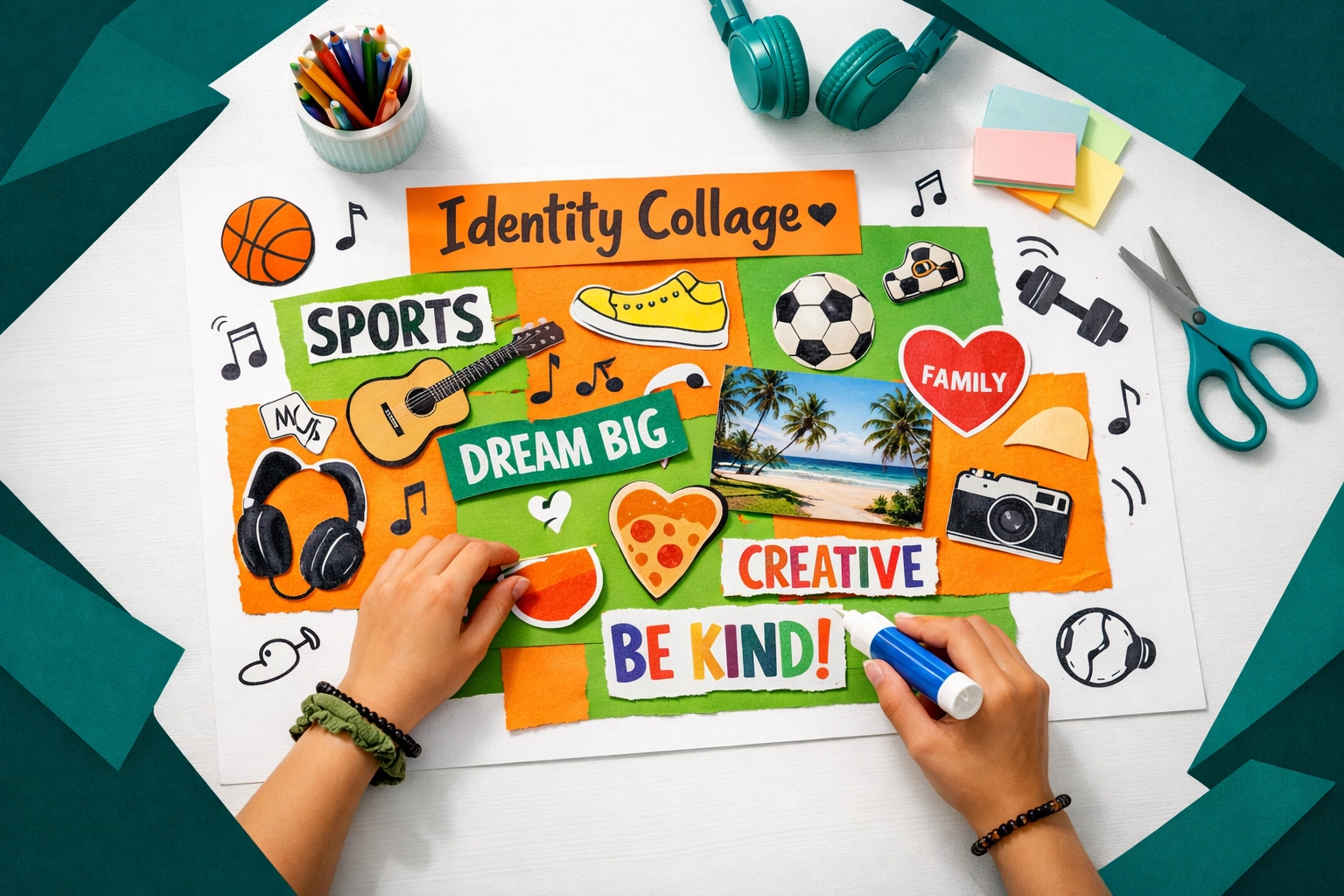
For kids who aren't big on words, art is a powerful bridge to self-awareness.
Give them a stack of old magazines, some scissors, and a board.
Tell them to find images and words that represent how they feel on the inside and how they want the world to see them.
The resulting collage is often a profound insight into their subconscious hopes and fears.
Display it somewhere prominent to remind them that their internal world is beautiful and worth sharing.
If your child loves the creative side of things, check out our drawing and painting classes to further unlock that self-expression.
Confidence is often tested in the context of other people.
Playing cooperative board games, where players work together against the game rather than against each other, is a goldmine for self-awareness.
Observe how your child handles a teammate's mistake or how they contribute to a strategy.
After the game, have a "debrief."
"I noticed you were really patient when we were losing. How did that feel inside?"
It helps them see themselves through the lens of their relationships and their impact on others.
In our quest to "equip" our children, we sometimes over-schedule the life right out of them.
True self-awareness often blossoms in the quiet, empty spaces of unstructured play.
When a child is left to their own devices: without a screen or a coach: they have to figure out what interests them.
They have to learn to navigate boredom and use their imagination.
This builds a deep sense of self-reliance.
They learn that they are enough to keep themselves occupied and that their own ideas have value.
We are standing on the edge of a new season.
Self-awareness isn't a destination: it is a journey that requires constant nurturing and the right environment.
It is about moving from "I can't" to "I can't yet, but I'm learning how."
As parents, we are the coaches in this process, but we don't have to do it alone.
Training your child in these life skills is the greatest gift you can give them: it is the gift of a firm foundation.
It is not about changing who they are, but about helping them become exactly who they were created to be.
If you are looking for a way to jumpstart this journey, the timing couldn't be better.
Our Easter Life Skills Bootcamp starts tomorrow, March 30, and runs through April 13.
This is a two-week intensive designed for kids (5–12) and teens (13–19) to transform their mindset and build the confidence they need for the real world.
For just £19.99, you can give them access to the Complete Life Skills Bundle, which is packed with the training they won't get in a traditional classroom.
Sign up for the Easter Life Skills Bootcamp here.
We are here to partner with you in this mission of stewardship.
If you have questions about which program is right for your child or how to get started, we want to hear from you.
Call our team: reach out to Rachel at +44 121 823 1456.
Or, if it’s easier, send us a quick message on WhatsApp.
Let’s help them build a life of purpose, one self-aware moment at a time.




Comments are closed